


Cut the Waste, Not the Mail
A Marketer’s Guide to Navigating USPS Rate Increases
As we celebrate the 100-year anniversary of the U.S. Postal Service, the milestone is met with a familiar challenge: another postal rate increase.
Since 2019, marketers have been navigating a steep upward trend in costs. Marketing Mail has seen a cumulative increase of 56.22% from 2019 to 2025, compared to a much more modest 8.7% increase from 2013 to 2018. (1) For comparison, the cumulative rate of inflation in the US during that same period was approximately 25.74%. (2)
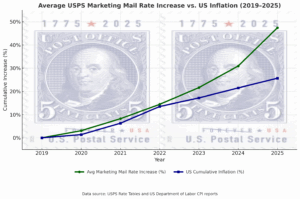
These consistent annual or bi-annual hikes have significantly impacted marketing budgets and strategy discussions, elevating Direct Mail from a tactical channel to a strategic conversation in the C-suite.
The most recent adjustment, effective July 13, 2025, introduced an 8.51% increase for Marketing Mail Letters and 9.61% for Marketing Mail Flats, averaging a 7.39% increase. With these changes, it’s more important than ever for marketers to be intentional about how they manage Direct Mail. The good news? There are effective ways to adapt, optimize, and even thrive under these conditions.
1. Don’t Drop Direct Mail – Double Down on What Works
In the face of rising costs, the knee-jerk reaction might be to cut Direct Mail altogether. But for B2B marketers, that’s often a costly mistake.
Direct Mail continues to deliver measurable ROI in B2B marketing especially when integrated with digital touchpoints. Unlike saturated digital channels, physical mail stands out and commands attention. When targeting high-value accounts or hard-to-reach decision-makers, Direct Mail consistently proves its worth through response rates, brand recall, and conversion.
When used strategically with fresh, clean data and a compelling offer, Direct Mail becomes more than a channel; it’s a competitive edge. Cutting it means potentially leaving qualified leads and revenue on the table.
2. Don’t Just Cut Volume – Cut Waste
Reducing your mail volume may seem like a practical way to manage your budget, but quantity alone isn’t the problem, waste is.
Instead of sending fewer pieces, focus on mailing smarter. A refined mailing list, better segmentation, and timely targeting can do far more to protect your budget than simply mailing less. Cutting waste through cleaner data and sharper targeting helps you reduce costs without sacrificing reach or impact.
3. Optimize to Offset – Finding Cost Savings Without Compromising Quality
There’s no shortage of ways to optimize your Direct Mail campaigns without abandoning them. In fact, with the right strategies, marketers can leverage current USPS programs to work in their favor.
Take Advantage of USPS Incentives
USPS offers a variety of promotions and discounts designed to encourage smarter, higher-volume mailings:
- Growth Incentives: Earn postage credits on mail volumes that exceed your 2024 baseline. This applies to both First-Class and Marketing Mail giving marketers a reason to mail more for less per piece.
- Marriage Mail Incentive: A 10% postage discount is available through 2025 for marketers who combine mailings with other brands. By sharing the cost, businesses can reach new audiences collaboratively and affordably.
- SCF Pallet Discounts: New discounts are available for First-Class Mail entered at the sectional center facility (SCF) level, helping reduce transportation costs for qualifying mailers.
When used correctly, these programs make Direct Mail more cost-effective even in the face of rate hikes. Visit the USPS.com for additional information on promotions and incentives to help reduce the cost of mailing. USPS Business Promotions & Incentives
Rethink Your Mail Piece
Small changes in format can yield big savings. Could a slightly smaller piece or lighter paper stock reduce your postage cost? Are there design tweaks that lower weight without sacrificing brand impact?
It’s also a perfect opportunity to test your creative. A/B testing different formats, messages, or calls to action can uncover which version performs best, improving both efficiency and results. Optimization isn’t just for digital anymore; with modern tools and tracking methods (like QR codes leading to dynamic landing pages), you can measure Direct Mail results with surprising precision.
Prioritize Data Quality
No matter how attractive your offer or how well-designed your mail piece, if it goes to the wrong address or unqualified prospect, it’s wasted money.
Bad data is one of the most common (and easily fixable) ways marketers waste money. Invalid addresses, outdated contact records, or generic lists often result in undeliverable mail or zero engagement. This is why your data strategy should be the first stop when evaluating Direct Mail ROI.
Want to know how much bad data is costing organizations?:
- According to Experian, 88% of companies have reported an average revenue loss of 12% due to wasted marketing spend and associated resources
- Gartner estimates that bad data cost enterprise companies an average of $12.9 million every year.(3)
- A MIT Sloan Management Review study found that the majority of companies attribute bad data to losses of 12-15% of their annual revenue. (4)
Assuming a mid-sized company mails 1 million pieces annually, with an average 7% undeliverable rate and a $1.25 cost per piece – their annual wasted spend totals $87,500. Add in the “lost opportunity” cost from not reaching qualified prospects, and they could be looking at well over $150K in annual loses. Now think about a company that mails 10,000 or 100,000 million pieces a year!
But it is not just deliverability that is an issue, it also the impact bad data can have on targeting.
In fact, Truthset (5) reports that:
- Big data is wrong as much as 60% of the time
- 39% of gender targeting is incorrect
- 73% of marketing spend targeting African Americans is wasted
- 83% of Age segments are inaccurate
So, as you bring in 3rd party data to power your campaingns, ask yourself the following questions:
- Do you know where your data originated?
- How precise is the targeting?
- Is it regularly verified and updated?
- What’s your process for removing duplicates, invalid records, or unresponsive recipients?
Investing in accurate, high-quality data ensures every dollar spent is working harder for your campaign. Clean data leads to higher deliverability, better targeting, and ultimately, better results.
How Crosslists Data Helps You Win in a Rising-Rate Environment
At Crosslists Data, we understand that smart growth starts with smart data. Our mission is to empower marketers with the real-time, verified data they need to drive precision and performance, even when costs are rising.
By delivering clean, timely address data, we help you:
- Avoid costly waste by eliminating bad addresses and duplicates
- Reach the right contact at the right time, increasing engagement and ROI
- Integrate triggers and segmentation for more personalized, relevant messaging
The truth is, rate increases aren’t going away but with the right data and a purpose-driven strategy, your Direct Mail doesn’t have to suffer. In fact, it can thrive.
As we look ahead, one thing is certain: postage will continue to rise. But with a smart approach, Direct Mail doesn’t have to be a casualty, it can be your most consistent performer.
References:
- HVDMA Webinar Presentation
- Consumer Price Index (CPI) from the U.S. Bureau of Labor Statistics (BLS)
- How to Improve Your Data Quality, Gartner, 14 July 2021
- Seizing Opportunity in Data Quality, MIT Sloan Management Review, 27
- Truthset Data Validation